
Why Premium Financing Is Dangerous for Most Investors (And What You Should Know Before Borrowing to Invest)
Introduction: When Borrowing to Invest Goes Wrong
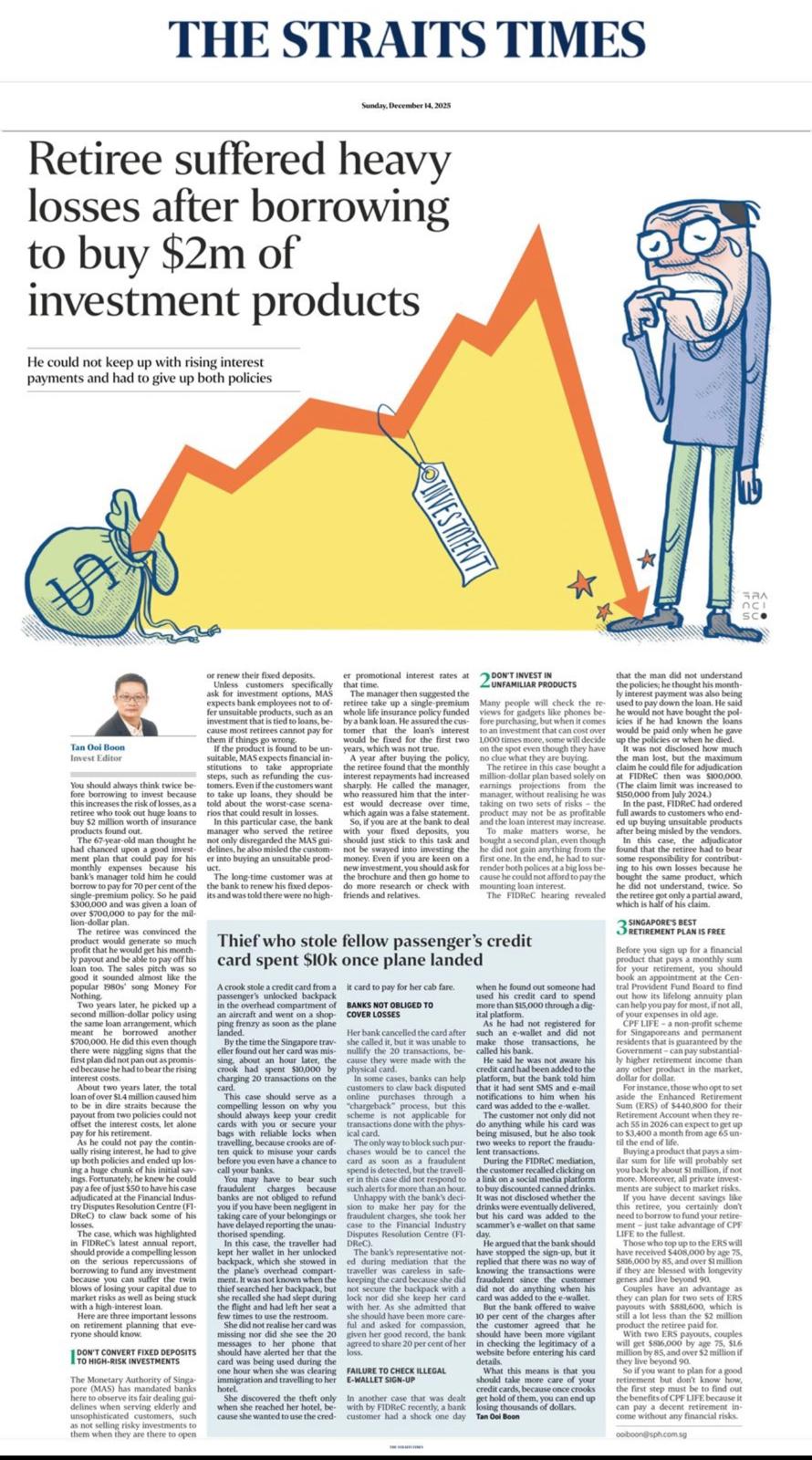
A recent Straits Times article highlighted a troubling case: a retiree borrowed millions to purchase investment-linked products, only to suffer heavy losses when interest rates rose. Unable to keep up with increasing loan repayments, he was eventually forced to surrender both policies—locking in significant financial damage.
While extreme, this case is not isolated. It highlights a growing issue in wealth planning today: the dangers of premium financing and borrowing to invest without fully understanding the risks involved.
This article explains—clearly and objectively—why premium financing can be dangerous for most investors, especially retirees and professionals using long-term capital.
What Is Premium Financing? (In Simple Terms)
Premium financing is a strategy where an investor borrows money—usually from a bank—to pay insurance premiums or invest, with the expectation that:
-
Investment returns will exceed borrowing costs
-
Dividends or policy cash values will service the loan
-
The strategy remains viable long term
On paper, it can appear efficient.
In practice, it introduces multiple layers of risk that many investors underestimate.
1. Borrowing Magnifies Losses, Not Just Returns
One of the biggest misconceptions about premium financing is that it is a “smart leverage” strategy.
In reality:
-
Loan interest is fixed or floating—but always payable
-
Investment returns are uncertain
-
Market volatility affects asset values, not loan obligations
If returns underperform or markets decline, the loan does not adjust.
This mismatch is where problems begin.
2. Interest Rate Risk Is the Biggest Threat
Many premium financing strategies are designed during low interest rate environments. However, interest rates are cyclical.
When rates rise:
-
Monthly interest payments increase
-
Cashflow pressure intensifies
-
Investors may be required to inject additional funds
-
Forced liquidation becomes a real risk
Most leveraged strategies do not fail because investments collapse—they fail because interest costs rise faster than expected.
3. Liquidity Risk: The Silent Killer
Premium financing often locks capital into long-term structures.
This creates a dangerous situation where:
-
Net worth may look high
-
But available cash is insufficient
-
Loan obligations continue regardless of market conditions
When liquidity dries up, investors are forced to make decisions at the worst possible time—often crystallising losses that could otherwise have been avoided.
4. Margin Calls Turn Paper Losses into Real Losses
Another critical risk in premium financing is margin calls.
If asset values fall or loan-to-value ratios are breached, banks may require:
-
Additional collateral
-
Partial loan repayment
-
Policy surrender
Margin calls usually occur during market stress—when selling assets causes permanent loss. This is not a hypothetical risk; it is a contractual one.
5. Why Premium Financing Is Especially Dangerous for Retirees
For retirees or those nearing retirement, premium financing poses amplified risks.
Retirees typically lack:
-
Future income to recover losses
-
Time to ride out long market cycles
-
Flexibility to inject additional capital
Using leverage during retirement is not strategic—it is irreversible when things go wrong.
6. “If the Bank Offers It, It Must Be Safe” — A Costly Myth
Banks structure financing arrangements to protect their own downside. This is standard risk management—not wrongdoing.
However:
-
Banks earn interest regardless of investment performance
-
Investors bear market losses and funding shortfalls
Understanding who carries the risk is critical before entering any leveraged strategy.
7. Who Is Premium Financing Actually Suitable For?
In limited circumstances, premium financing may be appropriate for individuals who:
-
Are ultra-high-net-worth
-
Have significant excess liquidity
-
Own multiple income streams
-
Can walk away without lifestyle impact
For most investors—especially those using retirement capital or long-term savings—the risks typically outweigh the benefits.
8. Premium Financing vs Proper Wealth Planning
Good wealth planning prioritises:
-
Cashflow sustainability
-
Risk alignment
-
Capital preservation
-
Long-term resilience
Premium financing, by contrast, often depends on:
-
Stable markets
-
Predictable dividends
-
Low interest rates
-
Continuous monitoring
Strategies that only work under perfect conditions are fragile.
9. The Real Cost of Borrowing to Invest
Beyond financial losses, borrowing to invest introduces:
-
Emotional stress
-
Decision fatigue
-
Constant monitoring
-
Anxiety during market volatility
True wealth should provide peace of mind—not persistent pressure.
10. A Better Way to Build Long-Term Wealth
Sustainable wealth and passive income are built through:
-
Diversification
-
Proper asset allocation
-
Time in the market
-
Risk-managed strategies
Borrowing may accelerate outcomes—but it also accelerates failure when conditions change.
Final Thoughts: Clarity Before Complexity
Premium financing is not inherently wrong—but it is widely misunderstood and frequently misapplied.
If a strategy:
-
Depends on borrowing
-
Breaks when interest rates rise
-
Requires constant intervention to survive
It is not a retirement strategy.
Before committing to any leveraged investment, it is essential to understand how it behaves under stress—not just during ideal scenarios.
Clarity today prevents regret tomorrow.
