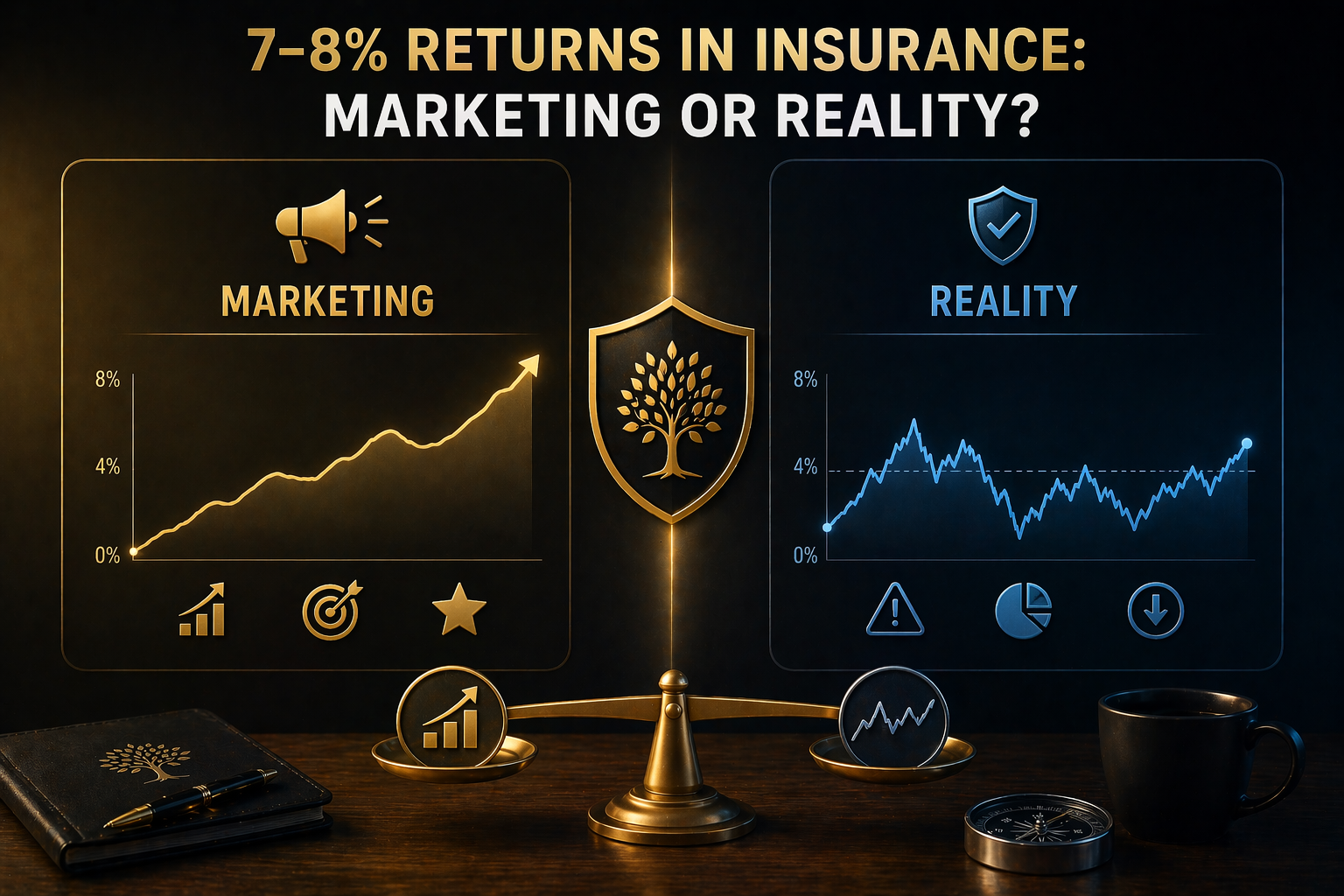
“Can this really give me 7–8% long term?”
That’s probably one of the most common questions I hear — especially when clients are reviewing illustrations or comparing different policies.
And to be fair, the numbers do show up.
You’ll often see:
- 7%
- 7.5%
- Sometimes even higher
On paper, it looks compelling.
But this is usually the point where I pause and ask a different question.
Where Is This Number Coming From?
Because before accepting any projected return…
👉 it’s worth understanding how that number was derived.
What Illustrations Are Designed to Do
Illustrations are not predictions.
They are:
👉 projections based on assumptions
These assumptions can include:
- Expected market returns
- Index performance
- Bonus declarations
- Policy charges
👉 In other words:
Illustrations show what could happen
—not what will happen.
Why 7–8% Shows Up So Often
This is not random.
In many cases, higher projected returns come from:
- Optimistic assumptions
- Backtested index performance
- Smoother hypothetical outcomes
Especially when custom indices are involved.
👉 Which means:
The number looks precise —
but the foundation behind it may not be as firm as it appears.
A Gap That Builds Over Time
This is where things become more significant.
Let’s say a policy is illustrated at:
👉 7.5%
But over time, actual performance comes in closer to:
👉 4–5%
At first, the difference doesn seem large.
But over:
- 10 years
- 20 years
👉 that gap compounds.
And eventually, it starts to affect:
- Policy sustainability
- Cash value growth
- Overall outcomes
This Isn’t About Being Negative
To be clear — this isn’t about saying:
👉 “7–8% is impossible”
It’s about recognising:
👉 It’s not guaranteed
👉 And it’s not always realistic across all market conditions
What Drives the Difference
From what I’ve seen, the gap usually comes from a few key areas:
1. Market Reality vs Assumptions
Markets move in cycles.
Some years:
- Strong performance
Other years:
- Flat or negative
Illustrations tend to smooth this out.
2. Index Construction
As discussed earlier:
- Custom indices may rely on backtested performance
- Volatility controls can limit upside
👉 So even if the illustration shows 7%…
👉 real participation may differ.
3. Policy Charges
Over time:
- Costs increase (especially in IUL structures)
- Charges impact net returns
👉 Which means:
Gross return ≠ Net outcome
Where I See Clients Get Caught
Clients sometimes come in with expectations like:
“This should grow at around 7%.”
And that expectation becomes:
- A mental benchmark
- A planning assumption
But when actual performance differs…
👉 it creates confusion.
A More Grounded Way to Approach It
Instead of anchoring on a single number, I usually guide clients to think in ranges.
For example:
- Conservative scenario
- Moderate scenario
- Optimistic scenario
👉 This creates:
- More realistic expectations
- Better long-term planning
- Fewer surprises
Why Conservative Assumptions Matter More
This is something I’ve found consistently.
Clients who plan based on:
👉 conservative assumptions
Tend to:
- Stay more confident
- Make better decisions
- Experience fewer disruptions
Because Ultimately…
The goal isn’t to:
👉 maximise projected returns
The goal is to:
👉 build something that actually works over time
A Different Way to Think About It
Instead of asking:
“Can this give me 7–8%?”
A more useful question is:
“What happens if it doesn’t?”
Final Thought
High numbers can be attractive.
But in long-term planning:
👉 What’s realistic matters more than what’s possible.
Because expectations shape decisions —
and decisions shape outcomes.
If you’re currently reviewing illustrations or comparing different policy projections, it may be worth stepping back to understand how those numbers are derived — and how they may play out over time.
👉 If you’d like a clearer breakdown of your policy projections and what they mean in practical terms, feel free to reach out via WhatsApp