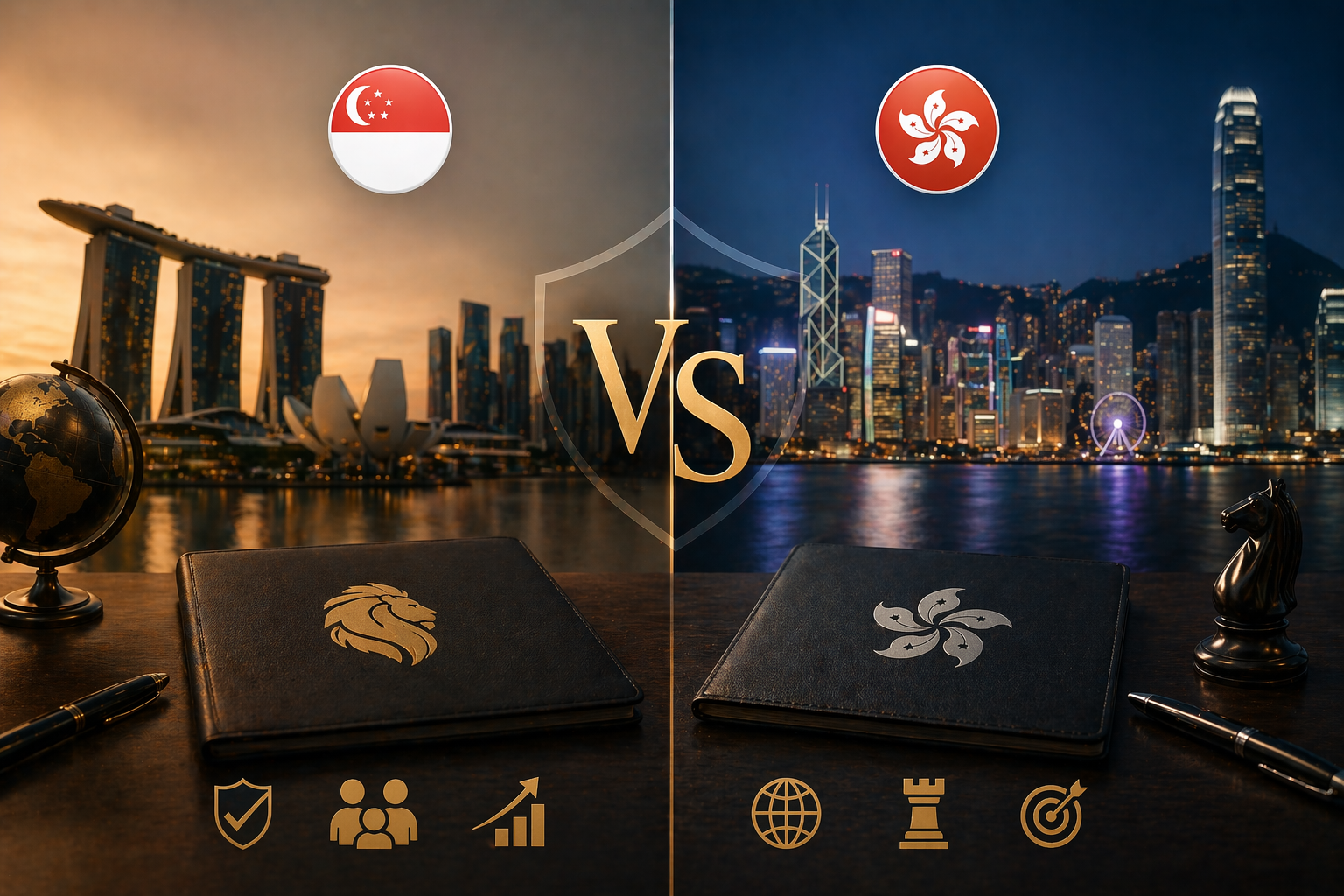
“Should I buy my policy in Singapore or Hong Kong?”
This question has been coming up more frequently in recent years.
And it’s understandable.
With more cross-border exposure and access to different markets, clients today have more options than before.
At first glance, the comparison often looks straightforward.
But in reality…
👉 It’s not just about the product.
👉 It’s about the environment behind the product.
Why This Comparison Is Often Oversimplified
Most discussions tend to focus on:
- Projected returns
- Premium differences
- Currency advantages
And while these are relevant…
👉 they don’t tell the full story.
Because the real difference lies in:
- Regulation
- Product philosophy
- How returns are generated
Singapore: A More Structured Approach
Singapore’s insurance landscape is shaped by:
- Strong regulatory oversight
- Conservative projection guidelines
- Emphasis on sustainability
What this means in practice:
- Lower illustrated returns (in many cases)
- More conservative assumptions
- Greater emphasis on long-term stability
👉 Some clients initially see this as a disadvantage.
But others see it as:
👉 A form of built-in discipline.
Hong Kong: A More Flexible Environment
Hong Kong operates differently.
It offers:
- Greater flexibility in product design
- Wider range of structures
- More aggressive illustrations (in some cases)
This creates:
- Higher projected returns
- More variability in outcomes
- Greater reliance on assumptions
👉 Again — this is not necessarily a flaw.
But it does change the nature of the decision.
The Key Difference: Philosophy
When you strip everything back, the contrast is this:
Singapore:
- Structured
- Conservative
- Regulated
Hong Kong:
- Flexible
- Market-driven
- Assumption-sensitive
Neither is inherently better.
But they suit different types of clients.
Where I See Clients Get Caught
Sometimes clients focus heavily on:
“The projected return is higher in Hong Kong.”
And that may be true — on paper.
But when we walk through:
- How those projections are derived
- What assumptions are used
- How returns are actually credited
👉 the conversation becomes more nuanced.
Transparency vs Flexibility
This is often where the real trade-off sits.
In Singapore:
- Greater transparency
- More consistent frameworks
- Easier to understand how things work
In Hong Kong:
- Greater flexibility
- More room for optimisation
- Less visibility into underlying mechanics
Currency and Jurisdiction (Another Layer to Consider)
For some clients, currency plays a role:
- USD-denominated policies
- Exposure to different markets
But beyond currency, there are also questions of:
- Legal jurisdiction
- Policy servicing
- Claims processes
👉 These may not matter immediately.
But over 20–30 years…
👉 they become increasingly relevant.
What More Experienced Clients Focus On
Instead of asking:
“Which country offers better returns?”
They tend to ask:
- How are the returns generated?
- What assumptions are being used?
- How stable is the framework over time?
- How does this fit into my overall portfolio?
A Pattern I’ve Noticed
Clients who prioritise:
- Clarity
- Structure
- Predictability
…tend to lean towards Singapore.
Clients who prioritise:
- Flexibility
- Optimisation
- Higher projections
…may explore Hong Kong options.
This Is Not an Either/Or Decision
For some clients, it’s not about choosing one over the other.
It’s about:
- Diversifying across jurisdictions
- Balancing different structures
- Aligning with long-term goals
Final Thought
Cross-border options can be useful.
But only when they are:
- Understood properly
- Structured appropriately
- Aligned with your overall strategy
Because in the long run,
it’s not where the policy is bought —
it’s how the structure is designed that matters.
If you’re considering policies across different jurisdictions, it may be worth stepping back to evaluate not just the returns — but how the structure behaves over time.
👉 If you’d like a second opinion on comparing Singapore and Hong Kong options, feel free to reach out via WhatsApp